
River City Field Guide
A Field Guide to Richmond's Trees
By Jordan Hale
Richmond sits right on the fall line, where the rolling Piedmont meets the flat Coastal Plain — and the canopy reflects both. Heritage hardwoods shade the historic districts while tall poplars and pines fill the county yards.
Knowing the species explains what you're seeing — and what to expect in a storm. A heritage oak's spreading crown, a tulip poplar's brittle height, and a dogwood's delicate structure each lead to different care.
This is a homeowner field guide, not a botanical key. When health or structure is in doubt, pair identification with an arborist assessment.
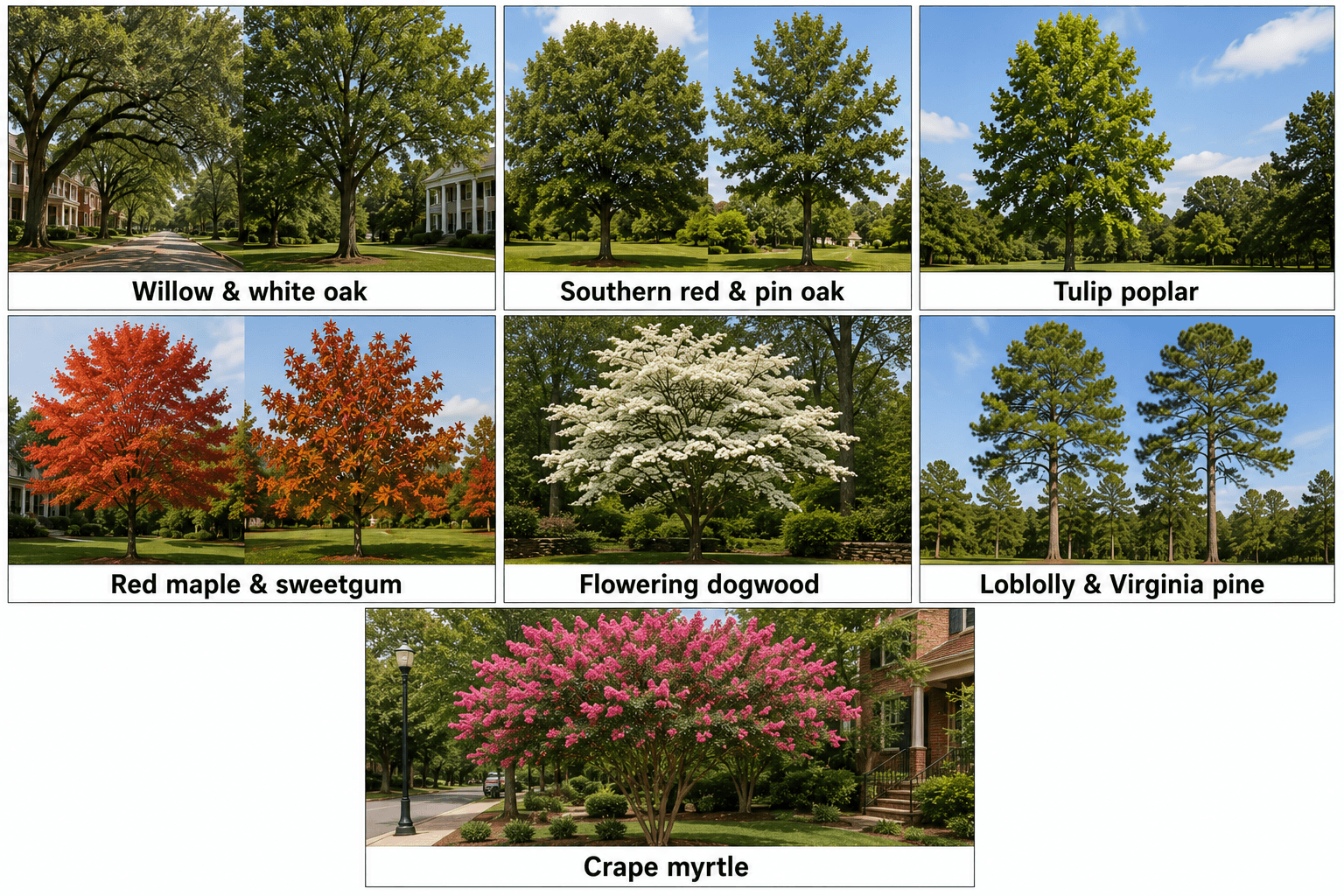
Trees That Define the Richmond Canopy
These species show up again and again from the historic districts to the counties and out along the James.
Willow & white oak
The backbone of Richmond's heritage canopy — willow oaks line historic streets, while slow, strong white oaks live for generations. Both reward structural pruning, root protection, and never topping.
Southern red & pin oak
Common shade oaks across the metro with bold lobed leaves and fast growth. They benefit from end-weight reduction and deadwood removal before storm season.
Tulip poplar
One of Virginia's tallest natives, with distinctive four-lobed leaves and tulip-shaped spring flowers. Fast and towering — and prone to shedding brittle limbs in high wind, making it a frequent storm failure.
Red maple & sweetgum
Red maples grow fast in yards and wet sites; sweetgums drop spiky balls and brilliant fall color. Both benefit from early structural pruning and canopy checks near structures.
Flowering dogwood
Virginia's official state tree and state flower — a beloved understory native with showy spring bracts. Dogwoods prefer protected root zones and light, selective pruning rather than heavy shaping.
Loblolly & Virginia pine
Fast-growing pines common in county yards and woodlots. Shallow roots and tall crowns make them vulnerable to wind and ice — worth checking for lean and snapped tops after storms.
Crape myrtle
The South's favorite flowering ornamental, everywhere in Richmond yards and streetscapes. It needs light structural pruning, not the harsh 'crape murder' topping that ruins its natural form.
Identification Changes the Care Plan
Species drives mature size, lifespan, decay patterns, storm behavior, pruning tolerance, and the season when work stresses the tree least.
It also sets what counts as normal. A tulip poplar simply behaves nothing like the white oak beside it, in growth rate, limb strength, and how it fails in wind.
Before heavy pruning, check the tree against our Richmond pruning calendar. If structure or health is uncertain, run through the hazard checklist.
Photograph the Clues That Matter
For ID, capture the whole tree, the branching pattern, bark, leaves or needles, any fruit or flowers, and buds when you can.
Include the site. Soil, drainage, root space, sun, and nearby construction often explain condition better than a single leaf close-up.
Send those with your project details and we can point you toward pruning, monitoring, or the right service.
Richmond Tree Identification Questions
What is Virginia's state tree?
The flowering dogwood is both Virginia's state tree and state flower. It's a common understory native around Richmond, prized for its spring bracts and best kept with light, selective pruning.
Why do so many Richmond poplars fail in storms?
Tulip poplars grow tall and fast with relatively brittle wood, so high winds from derechos and hurricane remnants snap limbs and tops. They're worth inspecting before storm season.
Is 'crape murder' really bad for crape myrtles?
Yes. Topping crape myrtles into stubs creates weak, whippy regrowth and ruins their natural form. Light structural pruning keeps them healthy and shapely.
Does species matter when deciding to remove a tree?
Yes, but never on its own. Expected lifespan, defect patterns, site fit, health, and the targets beneath the tree all weigh into the decision.
Keep reading
Related guides & services
Useful next steps from Richmond TreeWorks across Richmond.
Need Help Reading Your Trees?
Send photos of the tree and whatever's got your attention.
We can help narrow the species and recommend tree trimming, an arborist assessment, or removal when it's warranted.